
You know, I can’t really remember if I ever wrote an introduction of any sort. I have a thin blurb on the About part of this blog, and I may have alluded at some point to my profession, but I think I’ve really been just yapping into the void with no preamble.
So, hi, I’m a 38 year old software engineer who lives in the Portland, Oregon metropolitan area. I have four degrees (two of them minor), I’m married, and I have three kids, two of whom still live at home. All my kids are quite old, since my husband and I both separately and together got an early start on parenthood.
When I was growing up, I always knew I would go to college. Both of my parents had masters degrees in Food Science, and while I don’t remember any overt pressure to go to college, life coalesced around me with the understanding that I would be headed there someday. For what? Less important. In fact, barely important at all. The important part was going to college. I feel like this is a common refrain for millennials.
The odd thing about that expectation is that neither of my parents really positioned themselves to help me go through the actual movements that would get me to college. My senior year of high school, I had enough credits that I could leave the school before the last period of the day, and I had a friend who was taking classes at the community college, so I decided to take some college courses to fill my schedule.

Given that I was in California, community college courses taken by a high school student were free, so this was something that was largely driven by me, though my parents had to sign off on both my exit period and my college attendance, if I’m remembering correctly. When I didn’t have a car, I’d walk from my high school to my college, which took about an hour. When I did have a car, I drove. I took Cultural Anthropology one term and got an A, and then I took an immersion French course another term and got a B. Most of the latter class was self-directed, other than an immersion weekend where we weren’t supposed to speak English the entire time. This was horrifying for someone as introverted as me, so while I don’t remember the exact details of getting a B, I would guess that it had to do with my (lack of) willingness to speak during the immersion weekend.
So here I was, a high school student with every intention of going to college after graduation, who was even enrolled in college while still in high school, and after I graduated from high school … I just stopped. There were no, “So what colleges are you applying to?” conversations or, “Are you going to keep attending community college next term?” questions that I can recall. Granted, I was not in the best place in my life at this point, so maybe everybody was waiting to see whether I was going to swan dive off into the deep end, but in retrospect, it feels odd that the idea of me going to college after high school just fizzled out once we got there.
Fast forward three years, I am now a single mom of a one year old little girl. The topic of college finally comes up, and I am encouraged by my parents to go back to school. My mother offers to pay for it, but only if I don’t attend University of Phoenix, which has drawn my attention with their enormous advertising budget and the idea that I can work (highly necessary as a single mom) and go to school at the same time. I allow her offer to steer me away from University of Phoenix. She later renegs on her offer, but at least it did the job of keeping me away from for-profit education. I find a local community college who has (mostly) online degrees, and, with the encouragement of my then-boyfriend/now-husband, decide to do an Associate’s degree in Social Sciences.
I enrolled at Foothill College in spring of 2008. Yeah, that 2008. In August 2008, my now-husband and I were laid off in the same week, thankfully after classes had finished. I had a two month break to figure out our lives, because I was determined to keep taking classes.
We managed to find a place to land – of sorts – about a month later. A friend of mine lived with her mom, and while they didn’t have an extra bedroom for me, my daughter, my future husband, and his son, they allowed us to sleep in their living room while we scrambled to get ourselves back in a decent state. My now-husband, after much applying, found a job in public education, which started the timer for receiving his first check. When that showed up almost two months later, along with the unemployment payments I was now receiving and the rental deposit assistance we were able to get from Sacred Heart Community Services, we were finally able to get ourselves back into an apartment.
By this time, school had started back up, I was taking two classes, and I had found myself pregnant. Thankfully, the online learning was a great fit for my situation, so while my job search was not at all fruitful, I at least kept on track toward graduation. In spring of 2009, I gave birth to our youngest child, taking only one class that term to accommodate all that comes with a full term pregnancy and then a fresh newborn. I continued taking courses throughout his infancy, and in fall of 2009, I applied to a handful of schools in California, as well as two schools in Washington.
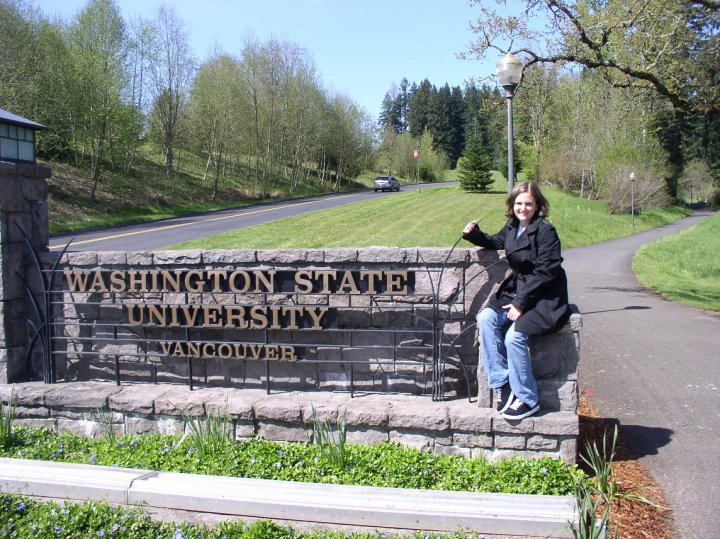
Washington State University – Vancouver is a satellite campus of the main Washington State University in Pullman. Vancouver, confusingly sharing a name with the major west coast Canadian city (we were here first!), is a suburb of Portland, Oregon, across the Columbia river that divides Washington and Oregon. My husband had applied and been accepted to WSU-V back in his college application days, but circumstances didn’t align for him to attend. He had really liked the college and the campus, plus we were looking for a way to get out of the Bay Area as it didn’t seem financially possible for me to attend school there full time with daycare-aged kids and him as the sole provider. I applied to WSU-V, and not only did I get in, but I got a partial scholarship! It was an easy decision to head north, and in summer 2010, we did just that.
Just like my AA, I decided to major in Social Sciences, because that gave me the most flexibility to choose between the submajors covered by this major – I took a lot of psychology and sociology classes. I really enjoyed this degree, discovering that I particularly loved psychological testing and measurement, as well as health psychology. I even considered doing a Psy.D. in Health Psychology for the military, at one point. But we were still slowly crawling out of the Great Recession and jobs were not plentiful in a place as educated as Portland, so I put my thoughts of grad school aside and started applying to jobs – any jobs – before I had even graduated college.
Luckily, my applications worked, and I found a job before I graduated in May of 2012. I switched to online classes for my last term so I could do both simultaneously. Unluckily, the kind of job I found myself doing after I graduated had absolutely nothing to do with my major, and everything to do with my prior work experience. This troubled me, because I now had $20,000 in student loans and was doing the same work I had been doing before I went to college. I started planning the next step, because my goal for our household was for my husband and I to each make $40,000 per year and I wouldn’t get there for many years in the low-level accounting role I found myself doing.
(As a side note, it’s funny thinking about how for me, back then, the idea of our household making $80,000 per year seemed absolutely luxurious. We were very poor!)
I graduated from WSU-V in 2012 and spent about a year researching what I was going to do to bring my income up. I had considered majoring in Computer Science when I was at Foothill College, but their major required a series of in-person Calculus classes and I didn’t have the ability to attend them. I was also afraid that it would be too hard for me, and that I wouldn’t be able complete the degree even if I made the schedule work. So I set it aside and moved ahead with Social Science.
Fast forward to 2013, in my research, I learned about Oregon State University’s brand-new (as of 2012) online post-baccalaureate Computer Science degree. As we were in the midst of a move back to the Bay Area, having decided that it was economically unsustainable for us to live in the Portland area for now, an online degree again seemed like a great option.
I explored a few other options, including Regis University and University of Illinois – Urbana-Champaign, but OSU’s degree was easily the best option as it was specifically tailored for career-switchers. It bundled up almost all general education credits under your previous degree, and so you only had to take Computer Science classes, rather than a smattering of random GE that your first school might not have required. I spent the end of 2013 taking an algebra class I needed for OSU, applied for fall 2014’s class, and was admitted in the spring of 2014.
2014 was a busy time for us. In addition to my application to OSU, we were on our second year of applying to graduate schools for my husband’s desired degree in Speech-Language Pathology. The first year, he had been rejected from all schools save one, where he was waitlisted and later rejected. Since all of these schools had been popular ones on the West Coast of the US, we took a different approach for the second year of applications: we looked at all the states that most people in the US don’t want to live in, we looked up graduate programs for his degree in those states, and we applied to a bunch of places we, and others, didn’t really want to live. This ended up being a winning strategy, as he was accepted to 3 schools this year, and ended up accepting at the University of Central Arkansas.
So, in summer of 2014, we both quit our jobs, rented a very cheap apartment sight-unseen, and moved our kids across the country to a town we’d never heard of in a state we’d never set foot in. In fall 2014, we both started our respective programs.
Now, I’ll admit that I still had a lot of self-doubt. What if I wasn’t smart enough for computer science? What if I took out even more student loans and couldn’t finish the program, leaving myself and our family in an even worse position than we were already in? I spent a ton of time stressing about this, and the first two classes I took did not do a ton to boost my confidence. The Intro to Computer Science course, CS 161, was very hard and had a steep learning curve for me. I’ll admit I cried several times over how hard it was to wrap my head around the things we were supposed to be doing. At the same time, the Discrete Math course was so confusing to me, and I never did get a hang of some of the types of proofs we were supposed to be doing. Nonetheless, I finished the first term with a B+ in CS 161 and an A- in CS 225, so I continued forward.
Each time, I thought to myself that I would try my best, and if I couldn’t hack it, at least I had finally tried. I gave myself permission to quit if it were apparent that I was not cut out for this career and subject matter. But each term, things got better. I still cried over some classes (the web development course was so bad that after my term, they temporarily shut it down and forced a rewrite of it) but the lowest grade I got the entire time was a B+, and the majority of my grades were A’s, so it started to feel more realistic that I could do this.
I pored over advice online, reading r/cscareerquestions religiously. Everyone there said that your best shot of getting a job after graduation was to get a summer internship. In-person internships in my area were few and far between, so I applied for as many online ones as I could find for my first term. I had a few interviews that went poorly, which made sense since I was early in my education at that point. My second application cycle (tech recruiting often follows the school schedule, with applications opening up late summer and a lot of the hiring concluded by spring for a summer internship), I had a much better resume with actual projects on it and while I wasn’t great at algorithmic-style interviews, I could at least fumble my way around.
By fall 2015, we were looking for our next place to live. My husband had nearly completed his graduate degree and for his final semester, he had to do a clinical placement. The exciting thing about this was that the clinical placement could be anywhere in the country, so long as the placement was willing to cooperate with his school in providing feedback about his performance.
We had a big decision to make – where were we going to want to live after this? We considered going back to the Bay Area, but ran into a similar problem to the one we’d had years back – he wasn’t able to work a job while doing the clinical placement, so I would need to find a job that paid enough to support our family in one of the most expensive metro areas in the US. We considered going to Seattle, where he had lived in the past. Seattle was expensive, but less so than the Bay Area, and somewhere we had considered living before. We also considered heading back to Vancouver, Washington, where I had job connections, the cost of living was lower, and we still had access to a major city in Portland, Oregon. When you put it like that, Vancouver was the easy choice. We also genuinely liked living in Vancouver and found it to be a great place to raise our kids. I finagled getting one of my old jobs back, my husband found a clinical placement outside of Vancouver but still within commuting distance, and we moved back to the West Coast.
In the midst of all of this, I applied to a job at a tech company who had a Vancouver office. I had been stalking their job board religiously, and so I applied to this internship the very first day that it opened. I had a recruiter call, which went well. I moved on to the manager call, which also went well. I then had a final round interview with two software engineers on the team. I was soooooo nervous! They asked me about my projects, and seemed to like that I had taught myself some AWS for one of my side projects. They asked me some technical questions about APIs and other things, and some of them I didn’t know the answer and said as much, but put forth my best guess. I wasn’t sure how I had done, especially as communication trickled off over winter break, but eventually they got back to me – I had gotten the internship!
Now, this internship was for summer 2016. After I accepted the offer, the hiring manager got back to me and said he had another offer: if I could take full time classes in spring of 2016, they could start the internship part-time in spring, instead of making me wait until summer. I took a look at my schedule, figured out how to make it work with my classes, and then negotiated with my new job to have a split schedule starting in spring. My new job was actually as a non-technical contractor for the same company I now had the internship with, so in the mornings, I would work the internship. I would spend the afternoons at my regular job, then I would go home and finish out my work for that job after normal hours. After that, I would attend to the three classes that I was taking to meet the full-time status required by HR for the spring internship.
I’m not going to lie, it was a lot. My family did not see a lot of me, as every evening and weekend was devoted to my classes. I strategically took one of the few remaining easy classes as my third class, which was good because my other two classes were Operating Systems (CS 344, at the time, CS 374 now) and Intro to Networks (CS 372). Those two classes were a ton of work, and I felt like I just ping-ponged back and forth between them, while giving the absolute minimum attention to the third class on my plate. Halfway through the term, my husband had to move back to Arkansas to do another clinical placement locally, so by June 2016, I was functionally a single parent, supporting two households, working two jobs, and taking full time classes. Again, it was a lot. But I pushed through, did the work, and ended up getting straight A’s that term. This is a period in my life that I am the most proud of, when I showed myself just how much I could handle at once and still succeed.
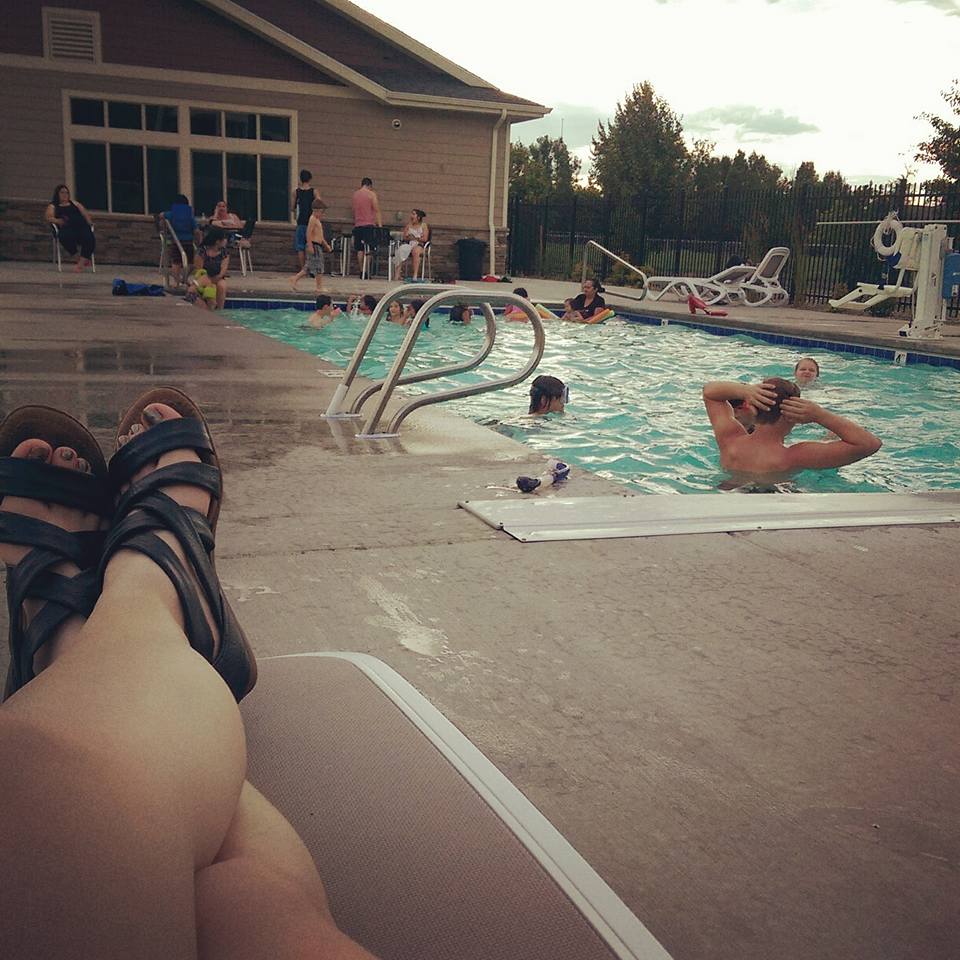
That first day of summer break, when I had no classes and had put in my notice to quit my non-technical job so I could do the internship full time over the summer, was really incredible. I took my kids to the pool that our low-income apartment complex had.
About halfway through the summer, I started to get nervous. The internship was going great, my team was all super nice, I was learning a ton, and I felt like I was really starting to gain some confidence in my ability to succeed in this field. However, software engineering internships usually end after the summer, and I had quit my full time job to do this internship. Furthermore, my old job had fallen victim to outsourcing, and almost everyone I worked with had been laid off in favor of sending the work to India. I was still the only person with a job in my household, and though my internship paid $10/hour more than my old full time job, I started wondering if I needed to start looking for a post-internship job.
First though, I approached my manager, and asked her about extending my internship through the fall. I was scheduled to graduate in December of 2016, and the best case scenario was an internship extension, followed by a full time offer that would convert me from intern to FTE after I graduated. The internship extension was easily granted, this time without the full-time class requirement, and I almost as easily was offered a full time software engineering role, effective the day after my graduation. It had all worked out!
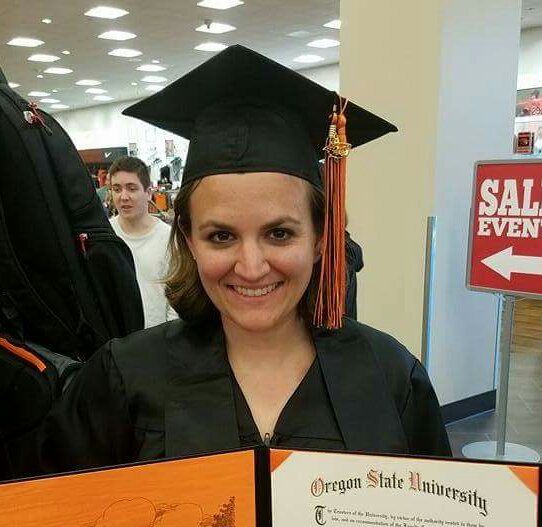
So that is the extended version of my experience with Oregon State’s Computer Science post-baccalaureate degree. It’s hard to imagine telling the story of OSU without all the context baked into the degree, going back to my first foray into college back in high school, so I hope I was successful at painting the full picture of how much this degree has meant to me. When I got my internship offer, I was making $13.55/hour (having negotiated my salary up to that rate!) at my full time job, or less than $30,000 per year. My internship offer was for $23.50/hour, or $48,880 annualized, and my full time offer was $75,900. While I didn’t just do this degree for the money, I would absolutely be lying if I said it didn’t factor into my decision-making, so getting an almost $50,000 raise over the course of a year was quite the payoff for that leap of faith back in 2014.
There’s a fair amount of noise online about Oregon State’s post-bacc program, and some very valid criticisms of it, but ultimately, this program changed my life for the better. Everything I have in life started with them offering an online degree aimed at career changers, and for that, I am forever grateful.
 Violet Sky
Leave a comment